
Brij Raj Swami Temple Nurpur — The Only Temple in India Where Krishna and Meera Are Worshipped Together
There are temples that you visit. And then there are temples that visit you — that stay inside you long after you’ve left. Brij Raj Swami Temple in Nurpur, Himachal Pradesh is firmly in the second category.
A Temple Unlike Any Other in India
India has thousands of temples dedicated to Lord Krishna. From the grand Dwarkadhish in Gujarat to the sacred ghats of Vrindavan, Krishna’s presence is felt across the length and breadth of this country. But there is one temple — tucked quietly inside the ruins of a 900-year-old fort in a small town in Himachal Pradesh — that stands completely apart from all of them.
Brij Raj Swami Temple in Nurpur is believed to be the only temple in India where Lord Krishna and Meera Bai are worshipped together — side by side, in the same sanctum, for over four centuries.
Not Radha. Not Rukmini. Meera Bai — the devoted poet-saint of Rajasthan, the woman who gave up a kingdom for Krishna’s love — is enshrined here alongside her Lord, as if the divine itself decided that their story deserved a permanent home.
This temple is not only a symbol of devotion but also an emblem of cultural pride for the people of Nurpur. What makes it so unique is the fact that it is the only temple in India where Radha and Krishna are worshipped together in their divine form — though more specifically, it is Meera Bai who stands beside Krishna here, making this shrine unlike any other in the country.
This is not just a religious site. This is a living legend. And at Anomrids Travel, we believe every devotee, every heritage lover, every traveller passing through Kangra district owes this temple a visit.
Nurpur — The Town Named After a Queen
Before we step into the temple, understand the town it lives in.
Once called Dhameri, the town of Nurpur traces its royal lineage back to the 11th century, when Jeth Pal of the Tomar dynasty founded a kingdom here. The Pathania rulers who followed gave the region both prosperity and pride.
Legend has it that Nur Jahan, the most beloved wife of Jahangir, visited Dhameri and was so enchanted by the serenity and natural beauty of the valley that the name was changed to Nurpur in honour of her. And in a twist of history that reads like folklore, local lore says that the clever Raja, unwilling to surrender his jewel of a valley, staged a crowd of goitre patients to convince her otherwise. The queen, alarmed, quickly changed her mind. The town, however, kept her name — Nurpur.
This is the kind of town Nurpur is. Layered. Witty. Full of stories that haven’t made it into textbooks yet.
The historic fort of Dhameri was built by Raja Basu Dev, the then ruler of Pathankot of the Pathania clan, in the late 16th century. The historic fort offers a mesmerizing view of Jabhar Khud, a tributary of a rivulet called Chakki.
Today, though its palace walls crumble and frescoes fade, the fort still whispers stories of courage, devotion, and timeless artistry. Its intricate carvings of animals, deities, and royal figures remain as fragile echoes of its grandeur.
And within those crumbling walls, standing firm and alive — the Brij Raj Swami Temple.
The Legend of How the Idols Came to Nurpur
Every great temple has a story. The story of Brij Raj Swami Temple is one of the most beautiful legends in all of Himachal Pradesh.
Raja Jagat Singh of Nurpur visited the Raja of Chittorgarh on the latter’s invitation along with the Raj Purohit. Next to the opulent palace that was assigned to Raja Jagat Singh and his priest was a temple. When the king went to rest at night, he heard the distinctive sound of ghungroos and music emanating from inside the temple. He listened for a few moments and then decided to take a peek inside the temple, where he found a woman dancing in the room, singing hymns in front of the idol of Shree Krishna. Astounded by what he had just seen, the Raja quickly narrated the events to his trusty priest.
What the Raja had witnessed, it was believed, was the spirit of Meera Bai herself — dancing in devotion for her Lord, as she had done throughout her mortal life.
It is said that one pair of idols, depicting Radha and Krishna in their eternal beauty, was being transported from Rajasthan. When the procession passed through Nurpur, something divine happened. The chariot carrying the idols stopped mysteriously near the fort and refused to move further. Despite several attempts, the idols could not be taken ahead. That night, the local king received a dream in which Lord Krishna himself commanded that the idols must remain in Nurpur, for this was where he wished to reside. The king, humbled and overjoyed, ordered the construction of a temple right there. And so, the Brijraj Swami Mandir was born — a temple that still holds those same idols to this day.
Some even say that during attempts to move the idols in the past, accidents or natural signs would occur, almost as if divine forces were ensuring that Radha and Krishna never leave Nurpur. This has strengthened the faith that the temple is protected by the gods themselves.
Whether you come as a devotee or a sceptic, this legend wraps around you the moment you enter the fort. Some stories have a gravity that facts alone cannot explain.
Inside the Brij Raj Swami Temple — What You Will See
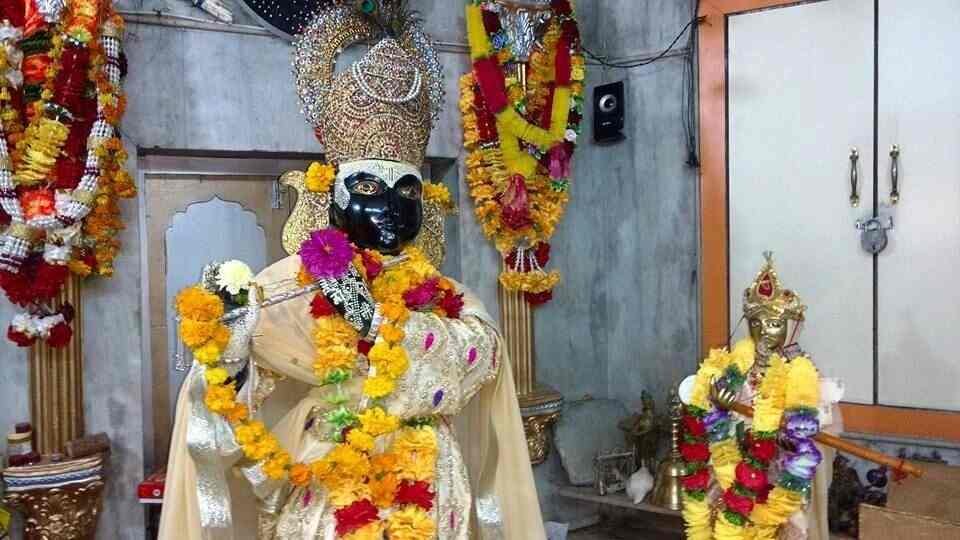
Inside the fort is the historic Brij Raj Swami Temple, built in the 16th century. It is unique as one of the few places where idols of Lord Krishna and Meera Bai are worshipped together. The temple features beautiful carvings depicting Krishna Leela.
Stepping inside the temple, one is welcomed by serenity and an aura of peace. The rhythmic chanting of bhajans, fragrance of incense, and the sight of Meera Bai eternally worshipping her Lord Krishna create a divine atmosphere that transcends time.
The main idol — the black stone idol of Lord Krishna — is the centrepiece of devotion. Beside it stands the idol of Meera Bai, eternally in worship, eternally at her Lord’s feet. It is a pairing that is visually and spiritually extraordinary. Nowhere else in India will you see this.
The temple architecture reflects a mix of local Himachali styles and influences from Rajasthan. The wooden carvings, the courtyard, and the ancient stonework tell stories of artisans who built it with both skill and devotion.
The walls carry faded frescoes — echoes of a time when art and faith were inseparable. Even today, its faded frescoes reflect a time when devotion and artistry were inseparable, binding the fort’s cultural and spiritual identity.
The atmosphere during aarti is something long-time travellers remember for years. The bhajans in this ancient space, the incense smoke curling toward a carved wooden ceiling, the idols lit in soft lamp light — it is one of those experiences that make Himachal Pradesh far more than just mountains and valleys.
The Nurpur Fort — A Living Heritage Site
The Brij Raj Swami Temple does not stand alone. It lives within the Nurpur Fort — and the fort itself is worth equal attention.
High on a rugged cliff overlooking the Jabbar river in Himachal Pradesh’s Kangra district stands Nurpur Fort, a weathered sentinel of history. Built nearly a thousand years ago, this architectural marvel has witnessed dynasties rise and fall, conquests unfold and legends take shape.
The fort is impressive in its design and architecture, and the wondrous carved panels of animals, figures of men, women, children, kings, gods, goddesses, and birds leave you awestruck. Even the carved roof of the fort is magnificent in its structure and detailing. However, the fort is in ruins because of natural conditions as well as the British, who destroyed most of the fort in 1849, and whatever was remaining was destroyed during the earthquake of 1905.
Though much of the fort lies in ruins today, the Brijraj Swami Temple remains intact, protected by both history and devotion. Visitors experience a rare combination of royal heritage and sacred spirituality within the same complex.
Today, the fort lies under the care of the Archaeological Survey of India. Walking through its remains — the deep niches, the decorative arches, the crumbling bastions — feels like walking through the pages of a history book that somehow never ended.
The fort also carries one of Himachal Pradesh’s most moving stories of resistance. Among them shines the tale of Wazir Ram Singh Pathania, a young prince who rose against British designs on Nurpur in 1848, nearly a decade before the First War of Independence. Betrayed during worship and imprisoned, he was sent to the dreaded ‘Kalapani’ and later to Rangoon. Tortured but unyielding, he died at just 24, a martyr for freedom.
Nurpur Fort is not just ruins. It is resistance, royalty, devotion, and legacy — all in one place.
Why Brij Raj Swami Temple Nurpur Deserves to Be on Every Himachal Itinerary
Most travellers heading to Himachal Pradesh rush straight to Manali, Shimla, or Dharamshala. And while those destinations are magnificent, the real soul of Himachal often lives in the quieter places — the ones that don’t have hashtags yet.
Nurpur is one of those places.
Here is what makes the Brij Raj Swami Temple Nurpur unmissable:
Historical Depth — A 16th-century temple inside a 900-year-old fort, within a town named after a Mughal empress. Every single layer of this place has a story.
Spiritual Rarity — The only temple in India where Lord Krishna and Meera Bai are worshipped together. If you are a devotee of Krishna bhakti, this is not optional — this is a pilgrimage.
Architectural Beauty — A blend of Himachali and Rajasthani architectural traditions, with exquisite carvings, faded frescoes, and temple artwork that has survived centuries.
Completely Uncrowded — Unlike Jwala Ji or Kangra Devi during peak season, Nurpur Fort and Brij Raj Swami Temple see relatively modest visitor numbers. You can spend real, unhurried time here. Darshan is smooth. The fort is peaceful.
Perfect Stop on Kangra–Pathankot Route — Nurpur is about 25–28 km from Pathankot, 60 km from Dharamshala, and around 40–50 km from Kangra town. It is easily accessible via the Pathankot–Nurpur–Dharamshala highway. It sits perfectly on the route between Pathankot and Dharamshala, making it an ideal stop on any Himachal road trip or pilgrimage circuit.
How to Reach Brij Raj Swami Temple Nurpur
Location: Nurpur Fort, Nurpur Town, Kangra District, Himachal Pradesh
| From | Distance | Travel Time |
|---|---|---|
| Pathankot | ~25–28 km | 40–50 minutes |
| Dharamshala | ~60 km | 1.5–2 hours |
| Kangra Town | ~40–50 km | 1–1.5 hours |
| Chandigarh | ~200 km | 4–5 hours |
| Delhi | ~490 km | 9–10 hours |
By Road: Nurpur sits on the Pathankot–Dharamshala highway (NH-154 / SH-28). From either direction, Nurpur is clearly signposted and easily accessible. The fort is within the town itself.
By Train: The nearest major railway station is Pathankot Junction, approximately 25–30 km away. There is also a small Nurpur Road station on the Kangra Valley Railway.
By Air: The nearest airports are Gaggal Airport (Kangra) — approximately 60 km — and Pathankot Airport — approximately 30 km. Taxis and cabs are available from both.
Anomrids Travel Tip: Nurpur is ideally visited as a half-day detour while travelling between Pathankot and Dharamshala, or as part of a full Kangra temple circuit. We strongly recommend combining it with Kangra Devi, Jwala Ji, Chamunda Devi, and Baijnath Temple for the complete Kangra pilgrimage experience.
Temple Timings and Practical Information
Fort Entry: The fort is generally open from morning till evening, approximately 9 AM to 5–6 PM.
Entry Fee: Generally free or nominal. Confirm on-site as it may vary.
Temple Darshan: The Brij Raj Swami Temple inside the fort remains active for worship throughout the day.
Best Time to Visit Nurpur: October to March for pleasant weather. The fort and temple are accessible year-round, though the summer months (April–June) can be warm in this lower-altitude region.
What to Wear: Modest clothing. Cover your head inside the temple. Remove footwear before entering the sanctum.
Photography: Allowed in the fort complex. Inside the temple, be respectful and follow any signs about photography restrictions.
Carry: Water, comfortable walking shoes (the fort involves some uneven ground), and cash for prasad.
Nearby Attractions — Make a Full Day of It
While in Nurpur, extend your visit to cover nearby places of interest:
Nagni Mata Temple — Just 6 km from Nurpur on the Pathankot–Kullu highway, this temple dedicated to Goddess Nagni is an important local shrine and a peaceful stop before or after the fort visit.
Nurpur Town Bazaar — A small, characterful market where local Himachali crafts and products are available. Worth a brief wander.
Chakki River Bridge Viewpoint — Near Nurpur, the Chakki River (a tributary of the Beas) offers picturesque views, especially from the bridge on the highway.
Kangra Devi Temple (Brajeshwari Devi) — ~50 km from Nurpur. One of the 51 Shakti Peeths. Combine with Brij Raj Swami for a memorable double-temple day.
Jwala Ji Temple — ~55 km from Nurpur. The eternal flame temple of Jwalamukhi. A natural extension for any pilgrimage day.
Anomrids Travel — Cover Nurpur on Your Himachal Pilgrimage
Brij Raj Swami Temple Nurpur is one of the most underappreciated heritage and spiritual sites in Himachal Pradesh — and it is a stop that Anomrids Travel includes in our broader Kangra pilgrimage itineraries for a reason. It completes the picture of what Himachal’s spiritual geography truly looks like.
🛕 Add Nurpur to Your Divya Himachal Temple Yatra
Our flagship Divya Himachal Temple Yatra — a curated 7-night, 8-day pilgrimage across Himachal Pradesh’s most sacred Shakti Peeths and ancient temples — is designed for:
- 👴👵 Senior citizens seeking a slow-paced, comfortable, medically supported pilgrimage
- 👨👩👧 Families and devotional groups wanting to do the complete Kangra Devi darshan circuit together
- 🙏 Pilgrims who want to cover Jwala Ji, Kangra Devi, Chamunda Devi, Chintpurni, and Baijnath in one well-organised journey
- 🌿 Heritage travellers who want to combine spiritual depth with Himachal’s rich historical legacy
Package Highlights:
- ✅ 6 Nights in clean, comfortable hotels
- ✅ Daily breakfast
- ✅ Dedicated Tempo Traveller — full tour, pickup to drop
- ✅ Priority darshan assistance at major temples
- ✅ Spiritual evenings — bhajans and satsang
- ✅ Medical support on call
- ✅ All tolls, parking, and driver charges included
- ✅ Optional wheelchair assistance (Premium plan)
Cancellation Policy: Cancel up to 24 hours in advance for a full refund.
Whether Nurpur fits into your existing Himachal itinerary as a quick detour — or you want to plan the entire Kangra pilgrimage circuit with us from start to finish — Anomrids Travel will make sure every kilometre and every darshan is exactly as it should be.
📞 Contact Anomrids Travel today to plan your Himachal Pradesh temple tour, the Divya Himachal Temple Yatra, or a custom Kangra pilgrimage itinerary.
Frequently Asked Questions — Brij Raj Swami Temple Nurpur
What is special about Brij Raj Swami Temple Nurpur? Brij Raj Swami Temple is believed to be the only temple in India where Lord Krishna and Meera Bai are worshipped together as a pair. Located inside the ancient Nurpur Fort in Kangra district, the temple has been a place of active worship for over 400 years and holds extraordinary historical, spiritual, and architectural significance.
Where is Brij Raj Swami Temple located? The temple is located inside Nurpur Fort in Nurpur town, Kangra district, Himachal Pradesh. Nurpur is approximately 25–28 km from Pathankot and 60 km from Dharamshala on the Pathankot–Dharamshala highway.
How old is Brij Raj Swami Temple? The temple was built in the 16th century — over 400 years ago — during the reign of the Pathania rulers of Nurpur. The fort it is housed within is even older, dating back nearly 900–1,000 years.
Is Nurpur Fort worth visiting? Absolutely. Nurpur Fort is a fascinating historical site with intricate stone carvings, faded frescoes, and remnants of royal architecture. Even in its ruined state, it offers a powerful sense of history, heritage, and the courage of the Pathania rulers who resisted Mughal and British domination.
How long does a visit to Brij Raj Swami Temple take? A visit to the temple and fort complex typically takes 1.5 to 2.5 hours. If you are a history enthusiast or wish to attend aarti, allow more time.
Is Brij Raj Swami Temple Nurpur part of any pilgrimage package? Yes — Anomrids Travel includes Nurpur and the Brij Raj Swami Temple in customised Kangra pilgrimage itineraries. Our Divya Himachal Temple Yatra covers the full Kangra Shakti Peeth circuit. Contact us to add Nurpur to your pilgrimage plan.
Is Nurpur accessible from Pathankot? Yes. Nurpur is just 25–28 km from Pathankot Junction, making it one of the most easily accessible heritage sites from Pathankot. It is a perfect first or last stop on a Himachal Pradesh road trip from Punjab.
A Final Word
India is full of temples. But it has very few places where a story as tender, as all-consuming, and as defiant as Meera Bai’s love for Krishna has been given a permanent, physical home.
Brij Raj Swami Temple Nurpur is that home.
Come to seek blessings. Come for the history. Come for the legend. Come because you’ve heard Krishna’s name a thousand times and want to stand, just once, before the place where Meera chose to stay.
Some journeys are about distance. This one is about depth.
Jai Shri Krishna. 🙏
Planning a visit to Brij Raj Swami Temple Nurpur or a full Kangra Himachal Pradesh pilgrimage circuit? Contact Anomrids Travel for custom itineraries, the Divya Himachal Temple Yatra package, and senior-friendly Himachal pilgrimage planning. We’ll take care of every detail — you just show up and experience the divine.